
Home/Product ranges/Hydraulics/Twin hoses
Selection guideTwin-hose reels
Replacing a reel or equipping a machine? Compare the AG and LS families for twin hoses, then check the part number and installation.
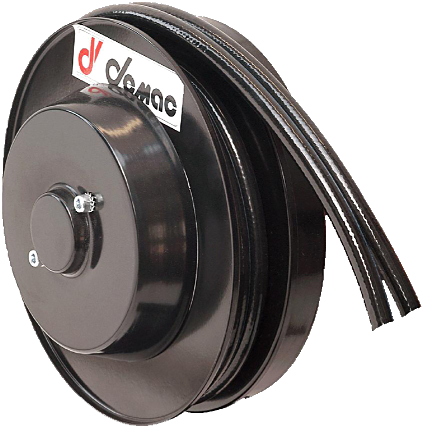
Choose a family
For twin hoses, start with the AG and LS families. Configurations with four or more lines are detailed in the full table.
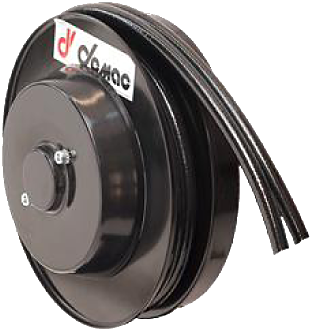
AG Standard
Twin hoses; the standard choice in the range with sixteen flange sizes.
View part numbers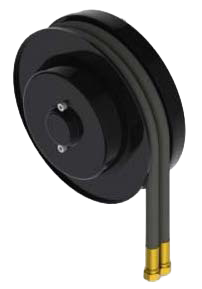
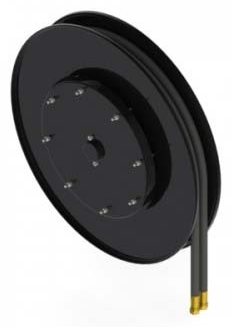
AG Compact
Twin hoses for a mast or narrow turret; reduced overall dimensions and shorter length.
View part numbers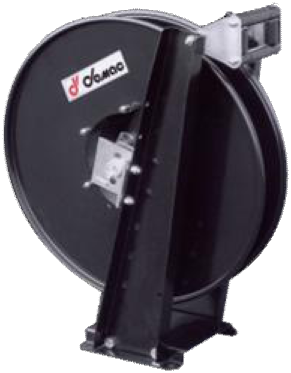
LS/300
Twin hoses with a locking latch to hold the unwound length; 300 bar version.
View part numbers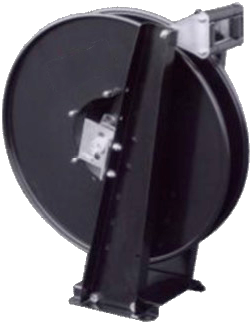
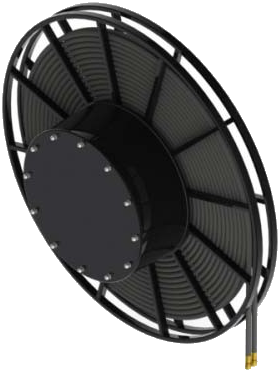
LS/700
Twin hoses with a locking latch; 700 bar version with Z3 hose.
View part numbersSpecific mounting or flow requirements — still two hoses
Your constraints, your family
Identify the family from the existing part number or the mounting and operating constraints.
On a small screen, scroll the table horizontally if necessary.
| Your situation | Family | What it offers |
|---|---|---|
| Standard requirement, no special constraints | 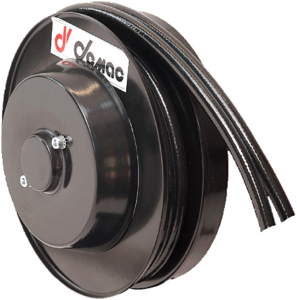 AG Standard AG Standard | Sixteen sizes, from 1,2 to 39 m usable length, 40 l/min. The reference. |
| Limited space — forklift mast, narrow turret | AG Compact | Less length, much smaller overall dimensions. |
| Mounting on a flat surface, without a projecting arm | 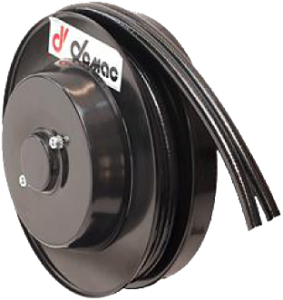 AG/F AG/F | Drilled flat flange, same lengths as the AG Standard. |
| Flow rate above 40 l/min | 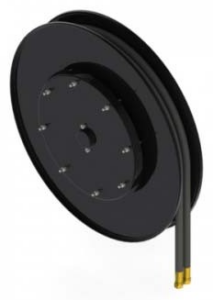 AG.19 AG.19 | Larger diameter, up to 80 l/min. |
| Long length and large diameter | 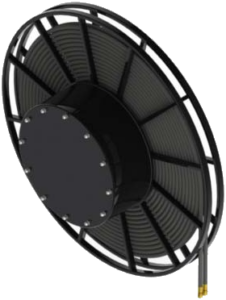 AG.25 AG.25 | Up to 1″, for long travel. |
| The hose must remain unwound at a given length | 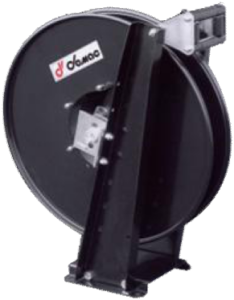 LS/300 LS/300 | Locking latch, 300 bar. |
| The same, at very high pressure | 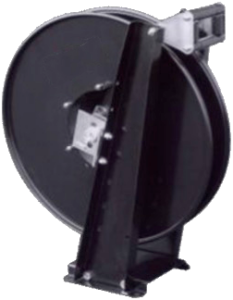 LS/700 LS/700 | Locking latch, 700 bar, Z3 hose. |
| Four lines — two twin hoses on one drum | 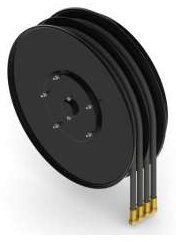 A4 A4 | Two twin hoses, fifteen sizes, up to 37 m. |
| Two components that do not move at the same time | 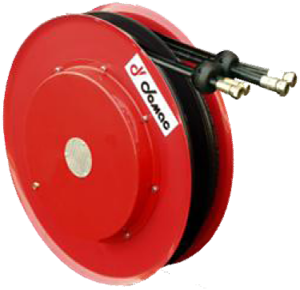 M4 M4 | Two independent springs, a single reel. |
| Five or six lines | 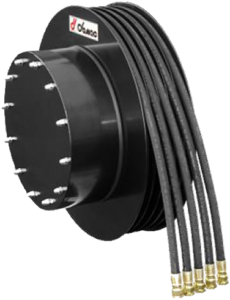 A5 and A6 A5 and A6 | Same lengths, 8 mm difference in width between the two. |
| An electrical cable is also required | AG/E and subsequent families | Cable in the same assembly. No loss of length. |
To filter by lines, flow rate, length and pressure, use the reel finder. If the part number cannot be identified, send the nameplate and photographs of the installation.
Check twin-hose assembly compatibility
Identify the one-piece twin profile, its construction, diameters and connections. This information complements the reel part number.
Compare the drum, width and guides with the existing hose assembly. Compatibility cannot be inferred from the number of lines alone.
Both lines belong to the same assembly: specify its construction and the conditions of each circuit. For a configuration with independent hoses, compare the separate hoses and their mounting dimensions.
Three checks before ordering
Pressure of the equipped assembly. Check the limits of the reel, connections and hose assembly. The twin-hose table gives the value by diameter and construction; a pressure option on the reel does not increase the hose rating.
Bend radius and drum. A 1/2″ B3 twin hose has a listed minimum bend radius of 150 mm, compared with 75 mm for an R8 of the same diameter. Check compatibility with the drum and usable length; these radii alone do not determine the reel’s overall dimensions.
Right-hand or left-hand version is selected when ordering. The suffix D or S determines which side the hose exits. On a mast or turret, the wrong direction makes the hose rub against the structure.
Figures for the twin-hose range
- Usable lengths from 1,2 to 39 m on the AG Standard.
- Diameters from 3/16″ to 3/4″, with 3/16″ available only in twin-hose construction.
- Pressures from 160 to 700 bar depending on the hose.
- Flow rates from 30 to 80 l/min depending on the family.
- Two constructions rated for −55 °C, R18 and CPLT5000.
Read a twin-hose part number
A part number is written AGD470.10.XX : AG the family, D the direction — right-hand —, 470 the flange diameter in millimetres, .10 the hose diameter in 3/8″, and XX the hose type to specify when ordering — R7, R8, B1, B2 or T2.
Enter the part number in the site search. If it is not found or remains incomplete, send it with a photograph of the nameplate without removing any suffixes.
What to send for a quotation
- For a replacement: full part number, photograph of the nameplate and views of the existing installation.
- Required usable length.
- Internal diameter, flow rate and working pressure.
- Available space and mounting hole centres.
- Connection direction, right-hand or left-hand.
- Mounting position — vertical downward travel requires the
/VD. - Fluid, temperature and environment.
Quotations and technical advice on request.